
Oopbuy product coupons and the first payment
Product coupons reduce the bill you pay when an item is bought. There are fewer of them, the labels are unexplained, and several product-side events pay out somewhere else entirely.
Two sets of product tickets, each listed twice
Twenty records in the public coupon list target the product bill. They form two sets, L1 and L2, with the same five rungs: ¥99-5, ¥199-10, ¥299-15, ¥999-50 and ¥1999-100. Each set appears in an original version and a copy with the suffix 0923. All share one window, from 16 September 2026 at 17:44 to 31 December 2026.
The product bill these tickets measure is the item price plus the seller's freight to the warehouse. Rungs are small relative to their minimums, smaller than the shipping ladder's, which fits a pattern across the list: the operator puts most of its coupon weight on the parcel bill.
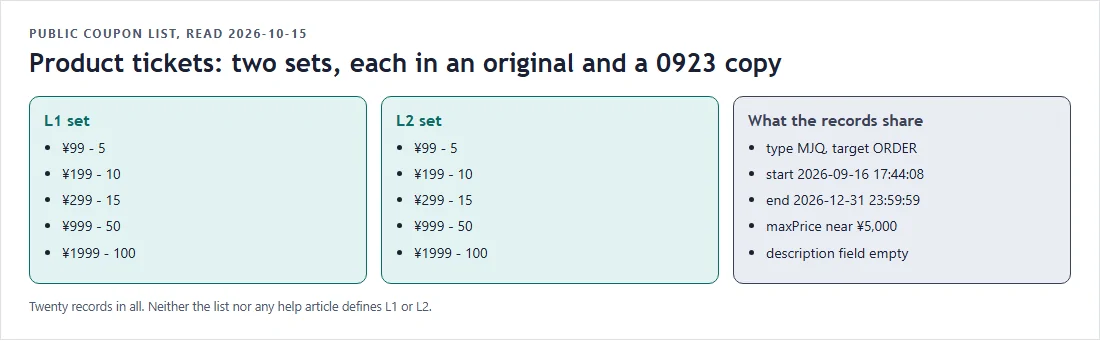
What L1 and L2 might mean, and what is known
Nothing on the public pages defines L1 or L2. The labels could refer to account levels, to two distribution groups, or to two campaigns. The duplicate 0923 versions look like a re-issue dated 23 September, but that is an inference from the suffix, not a statement.
What you can rely on is the record itself: the target is ORDER, the type is spend-and-save, and the minimum is measured on the product bill. If one of these appears in My Coupons, it will only be offered when you pay for items, never when you pay for a parcel.
What counts as the product amount
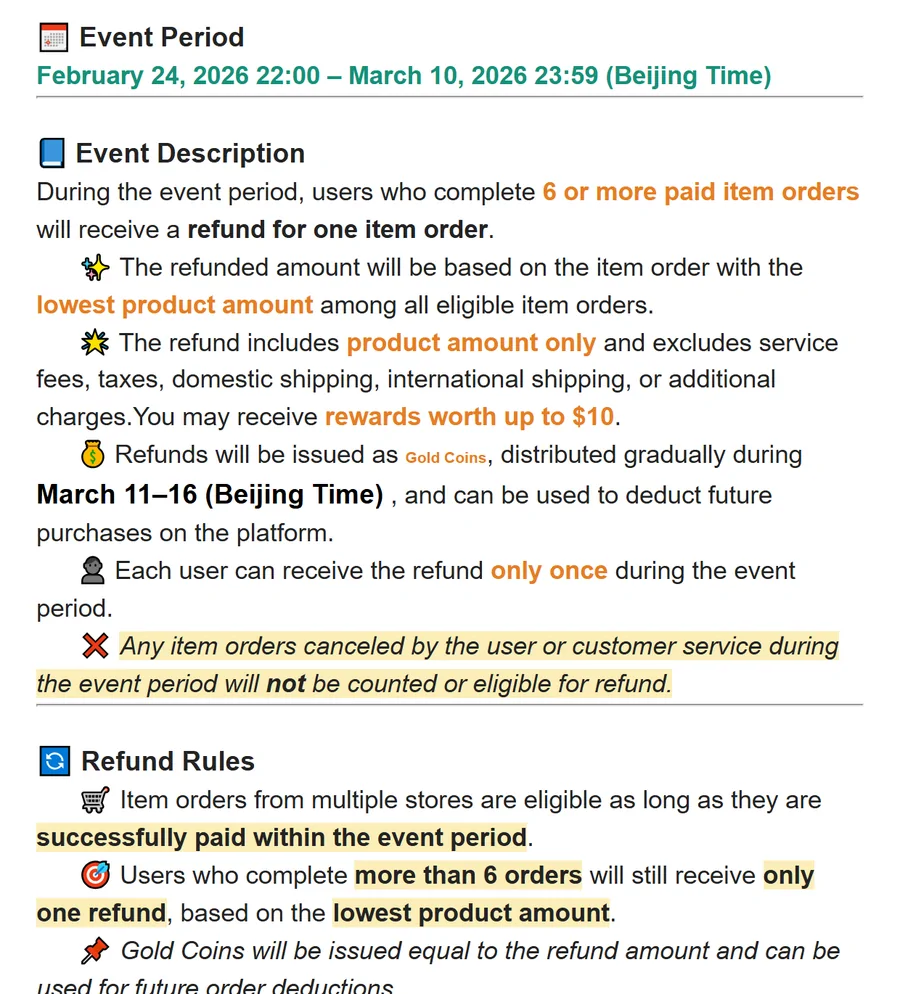
The coupon pages do not define the product bill, but two other official pages do define a product amount. The Buy 6 Get 1 rules say the refund covers product amount only and excludes service fees, taxes, domestic shipping, international shipping and additional charges. The product distribution rules say commission is based on the actual paid amount for the product, excluding shipping fees, service fees and coupon discounts.
Whether a product coupon's minimum is measured with or without the seller's freight to the warehouse is not stated. The fee page puts that freight inside product cost; the event rules leave it out of product amount. If you are close to a minimum, assume the stricter reading.
Rewards that are earned on one bill and paid into another
Several product-side promotions never touched the product bill. In November 2023 the operator gave 10% of each item's price as a freight allowance, deducted from international freight when the parcel shipped. In early 2026, Buy 6 Get 1 refunded the cheapest of six or more item orders, up to $10, as Gold Coins. In August 2026, the unboxing draw's grand prize waived a parcel's ¥698.56 shipping by issuing coins.
This is why we sort rewards by where they land, not by what they are called. A product promotion can pay out as a shipping deduction or a coin balance, and you only benefit if you know which.
Buy 6 Get 1: reading an event's own rules
The February to March 2026 event is a good example of how event rules add conditions that coupon records do not show. Six or more paid item orders qualified; the refund was based on the order with the lowest product amount; it came as Gold Coins distributed between 11 and 16 March; each user could receive it once; cancelled orders did not count.
None of those conditions would appear in a coupon list, because the reward was not a coupon. When an event pays in coins or cash, its own rules page is the only place the conditions live, and it is worth saving a copy before you take part.
Earlier product-side formats
Product discounts have taken several forms. In 2025 a group buy format cut prices by as much as seventy percent when two people, one of them new, completed a group within 24 hours, with a full refund if the group failed. A February 2025 spin-to-win handed out product coupons that expired three days after claiming. An October 2025 spinner listed product vouchers among its prizes. A September 2026 collection advertised prices as much as ninety percent below normal.
These are closed. We list them because the formats return, and the conditions (very short coupon life, group deadlines, collection-only pricing) tend to come back with them.